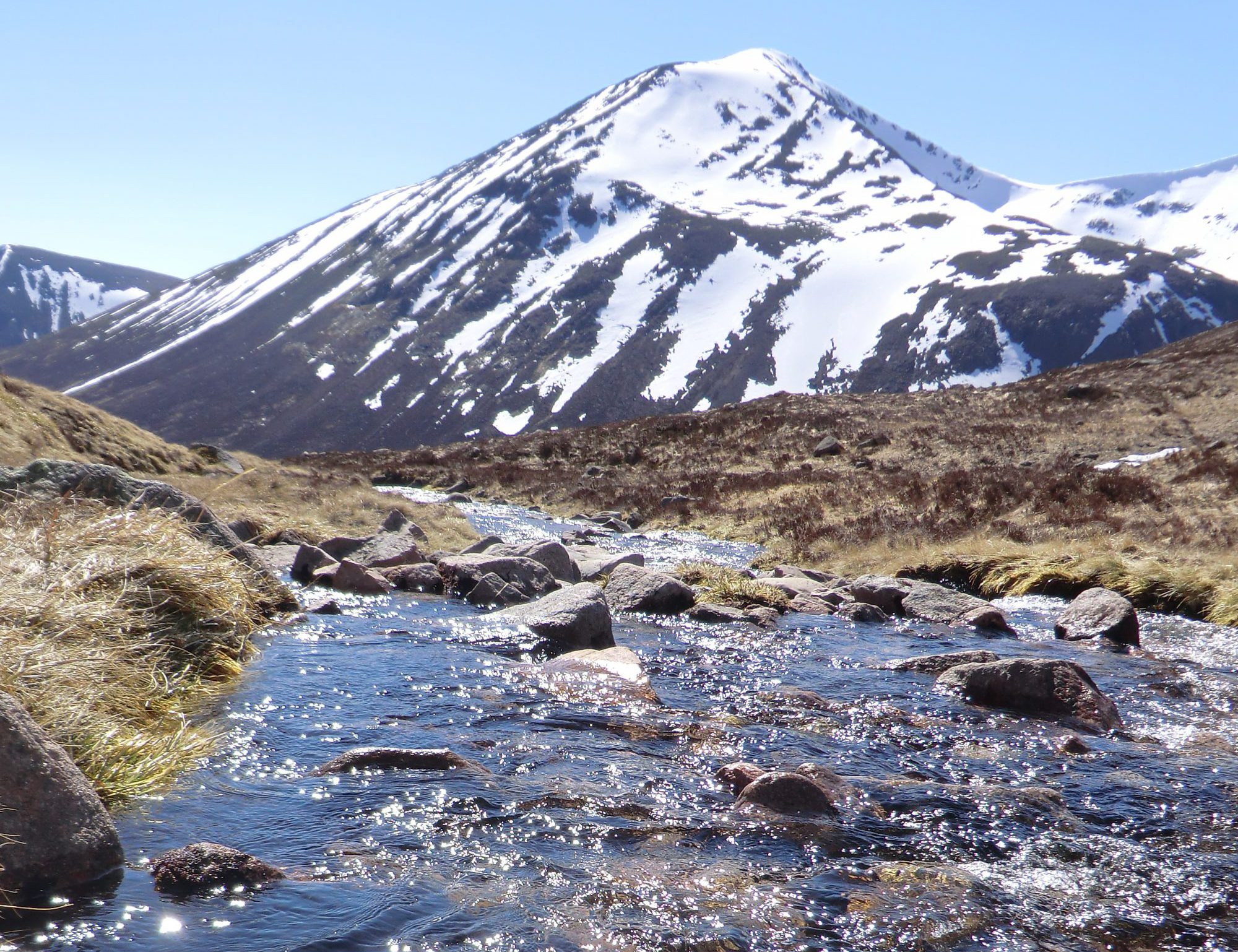
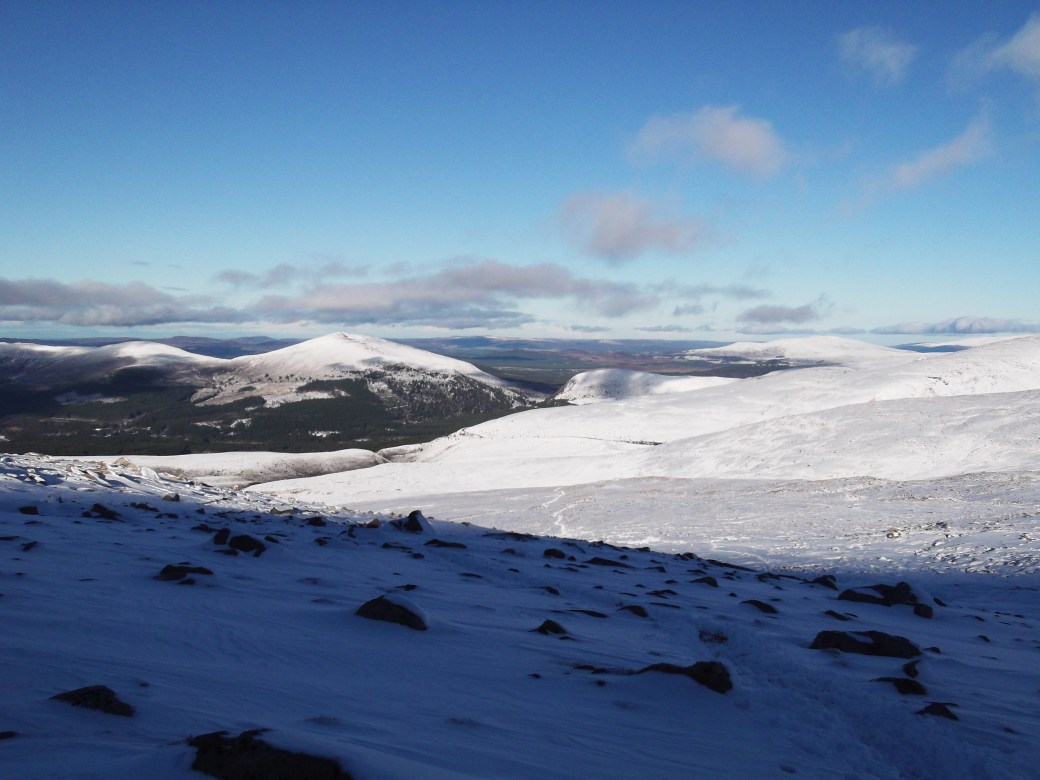
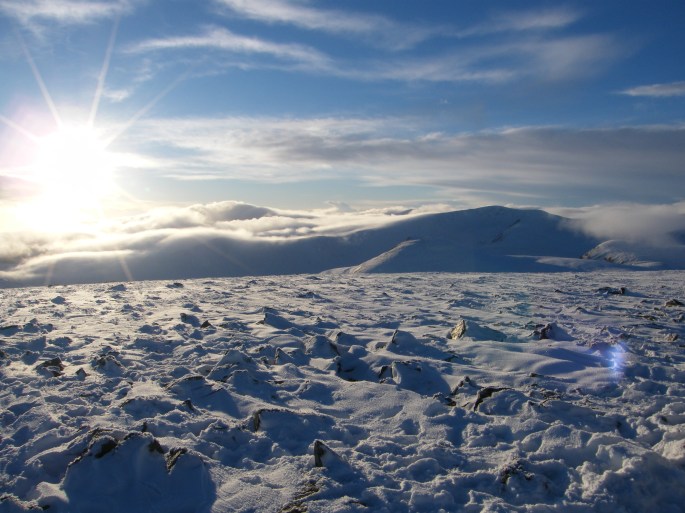
After attending a fairly demanding winter mountaineering course last weekend, and then following this up with four days of intensive horse riding, a straightforward hill day was definitely in order. So we decided on a shortish jaunt – up Glen Callater then onward to Carn an Tuirc and Cairn of Claise. Winter is definitely in retreat – there was very little snow underfoot. The main photo shows some lying on the high Eastern Cairngorm plateaus, while the odd cornice was still clinging to various precipitous edges. Of course, it’s still only March and winter could yet return with a vengeance…. watch this space…..
[Guest blog by Iain, aka the mountaineer who likes to have a sleep on summits. He’s even been known to take the odd nap on 14, 000 fters when the conditions have been right..]
Jasmin is away, so that usually means one of two things in winter (assuming I do actually get out of bed): find somewhere sunny to sleep on a mountain or head out on snowshoes…or ideally both. I was once wakened by the sound of someone taking my photo on the top of a snowy peak – they commented that they had never seen anyone look quite so pleased with themselves as they slept. Admittedly sleeping in snowshoes does take practice (no lying on your stomach) and can be quite a danger to the knees and ankles if attempted by the non-expert. Today was definitely not going to be a sunshine day, so it was clear – assuming I could get to the mountains after the recent snow – that it would be a snowshoe only day.
Mention snowshoes in this country and you are almost guaranteed to get one of two responses. The first is: “oh, those things that look like tennis racquets?” The second is: “not much call for those here?” For the first response: no, they don’t look anything like tennis racquets and I have no idea why we all seem to think that they do (was it in a movie or something?). I’m sure I held this image until a few years ago as well, but they probably haven’t for several decades. It is simpler to suggest anyone interested does a search for MSR and snowshoes than for me to try to describe them. For the second response…no, definitely not true either, as today’s outing clearly demonstrated.
L-R: 1) MSR Evo; 2) Amazingly cheap yet easy to fit and resilient Tchibo snowshoe 3) TSL women’s snowshoe
I don’t know how many different types of snow there are, or how many of these require snowshoes, but we definitely get at least one of these snowfalls in Scotland most years when without snowshoes getting up a mountain can prove to be almost impossible. When there has been heavy snowfall and the snow pack is unconsolidated, there are several approaches to getting up a mountain: get there late, when others have already done the work and you can simply follow in their footsteps; be part of a decent-sized group who can take turns breaking trail; be built like a bulldozer with the energy of the Duracell Drummer Bunny; or take snowshoes or cross country skis. Well, the skis do have their advantages once you get up the steep parts and can cruise across the plateau (though they are more cumbersome when not being worn), but I have certainly been on mountains where those on skis failed to get up (especially if it is icy) whilst those on snowshoes, armed with aggressive claws and serrated metal strips on the underside, had no problems.
The underside of snowshoes: MSR’s serrated ridges vs.Tchibo claws and TSL’s front claw plus six spikes
Today, with little desire to drive very far, I was heading for Glen Muick. The weather didn’t look great, so I thought I would just do Broad Cairn and Cairn Bannoch – a decent enough day out in winter. Unfortunately I had slept badly and put my back out…which takes one to the first problem with snowshoes: you have to carry them when you aren’t wearing them. Now apparently George Mallory, when sorting out kit for his 1924 Everest attempt, had asserted that 1 kg on your feet was equal to 6 kg on your back. Well, maybe for tough guys like him, but I would definitely rather have an extra 500 g (or 1 kg…if he meant per foot) on each foot than 6 kg extra in my rucksack! However, don’t think you can ditch the crampons just because you have snowshoes – a number of times (notably the descent off Glas Maol after a day of puttering around the Glenshee hills) I have had to change over to crampons to get back down safely in icy conditions. Today my back was nearly bad enough to decide against the snowshoes (which clip on very nicely to the side of a rucksack, as long as it has buckles on the compression straps – otherwise undoing and doing up the straps is a right battle). The walk along Loch Muick made me think I had made the wrong decision, as the snow was no more than ankle deep and was fairly well compacted. However, once I got to the turn up Broad Cairn suddenly there was only one set of tracks and they were startlingly deep – in fact more than knee-deep at times: exhausting. Instead, on with the snowshoes and a fairly easy walk up the steep zig-zag path. The tracks were clearly those of someone who had gone up and then returned in their own footprints – that they even got as far as the top of the steep slope before turning back earned my respect. How far would I have sunk in without them? Well, I was barely going in to my ankles next to where the heroic boot-shod walker had been up to their knees. The soft heavy snow was bad enough that I could easily push a walking pole in all the way to the handle – as happened a few times when I fell over. An outstretched arm would have disappeared up to the shoulder. Once I had reached the end of the track at the pony hut, at about 700 m, the need for snowshoes rather disappeared – this seems to be pretty common for Broad Cairn, a number of times I’ve done the circuit of the Loch Muick hills in crampons only to need the snowshoes for the walk back when down to the track. Fortunately I was wearing some quite short snowshoes – specifically the MSR Evo in their smallest guise (not much longer than the children’s model) – which are perfect for fitting onto a 45 litre pack, can easily be worn all day without you tripping over them and, if the snow gets too deep, you can simply screw on the detachable tails, which add another few inches to the backs and give additional floatation.
On getting back to the top of the steep section a few hours later, I found that by now quite a number of Duracell Drummer Bunnies had been up and a track had indeed been worn into the snow….but nobody had made it any further than that point, not yet halfway to the summit.
So, no they don’t look like tennis racquets, and yes you do need them in Scotland….so why have I never seen anyone else wearing them I wonder?
Conference. As an ex-academic, the very word strikes a chill in my heart. Those agonising long hours (or rather weeks) of putting a paper together, together with all the visual aids and music (all intended to keep your audience vaguely conscious). Getting steadily more nervous as the time for your paper draws nearer – only to find that because your presentation was right at the end of the final day and as the previous delegates had overrun massively, only two or three of your stalwart acquaintances have elected to listen to what you have to say while all the others have disappeared in search of alcoholic refreshments – and then to find that halfway through the cleaner wanders in, looking completely bewildered to have stumbled upon the world of Eighteenth Century Venetian Sacred Vocal Music, and who then interrupts to enquire: ‘Mind if I hoover the floor now, love?’ Or the conference where you’re regarded as ‘the new kid in town’ and as it is tradition to give just one speaker (usually the person who’s rashly trying to infiltrate their protected ranks) a very hard time, you absolutely know it’s going to be you. And lo and behold, you deliver your paper unto your very hostile audience, before the ‘head of the clan’ embarks on a scathing dressing down of what they think you’ve written…. and then (yes, it gets worse) while you’re still in the stunned state of ‘I can’t believe this is happening’… and then, more indignantly, ‘did you even listen to anything I said?’, someone shoves a microphone in your hand and you are required to reply – diplomatically of course. Nightmare.
But however nerve-racking my past conference experiences have been, as an ex-academic I know that conferences are the Done Thing and Very Important For Keeping Yourself Informed And Up To Date About Your Field. So when I saw the Mountain Training Association (MTA) Winter Conference advertised, I knew that it was a must. And anyway it didn’t seem to be the type of conference I had experienced in the past. It was made up of a variety of workshops from which you could select two to attend over the weekend. No lengthy keynote address to have to sit through. No stress of having to deliver a paper. Just turn up, attend with the opportunity to refresh skills, to develop as a professional and to meet like-minded people. And it would mean treading the hallowed corridors of Glenmore Lodge once again, my alma mater for all my mountain training to date.
Old habits of a lifetime are hard to break, however, and I found myself getting more and more wound up before I drove over to Aviemore last Friday. Rationalising wasn’t helping. Nothing really helped except, perhaps, a very large bar of chocolate – and that only for a short time. However, as soon as the first workshop began, and I became immersed in the world of winter navigation, all doubts and fears faded. We had a cracking session that had us switching between orienteering and larger scale maps. And while the conditions initially underboot were not those of deep winter, the weather at least obliged by providing a suitably low cloud base at times and then snow. Plenty of time for discussion on strategy – and, in a very natural way, many other bits and pieces fed into the navigation picture, such as refreshing the idea of planning a route with avalanche awareness in mind and so on.
Fiacaill Ridge
On Sunday we woke up to a white world. My second workshop proved to be equally as captivating. One of the highlights was being able to share all manner of professional and personal experiences with others, to ask our instructor as many questions as the day was long and to be out there experiencing a winter day in terms of working with a group in winter conditions. As winter is a very different prospect to summer, we explored the idea that decision making throughout the day is very much a dynamic process that has to take into account the conditions that are presently being experienced. There was one word to describe the day and our instructor: inspirational.
Views, views, views. Meall a’ Bhuachaille in the background
Out of all the CPD sessions I have attended over my rather chequered career as an academic and very short lived stint as a teacher (music aside), these MTA workshops really stood out above the rest. The reason is that these workshops were all run by instructors who do this stuff for real, they have a wealth of experience to draw upon, they know what it’s really like. They spend their time working closely with many different people, each with their own particular agenda for coming to the mountains, so they understand the importance of communication and how this needs to be modified according to the audience. My CPD sessions (and here I’m not talking about conferences) in the past have been a somewhat mixed bag, ranging from being a) so far removed from the reality of my work to b) being completely irrelevant, and being delivered by people who 1) had no ability to communicate with anyone and/or 2) had so little experience of the job I was doing that they could in no way be taken seriously. From depressing motivational speakers to time management courses that over-ran, I had been left wondering what the ‘P’ of Continuing Professional Development really stands for. But this particular conference succeeded in making me appreciate the true value of CPD when it is carefully matched to the needs of the professional: to be honest, I had never really understood what all the CPD fuss was about before this weekend.
As I drove back home (on rather slippery, snowy roads), I reflected on the experience of the weekend. The next time I see the word ‘conference’ I will no longer have to feel that chill striking my heart. Providing that ‘conference’ is preceded by ‘MTA’ that is.
[Note: Many thanks to the MTA for organising this most valuable conference, to the amazing instructors who delivered the workshops and also to Glenmore Lodge for the comfortable accommodation, great food – and, most importantly, that traditional tea and cake, always ready and waiting for us when we came off the hill.]
After much debate last night, which revolved around ‘how much further is it really to drive around to the Northern Corries rather than going out to Linn of Dee – it can’t be that much longer, can it?’, we bit the bullet, got up way before the crack of dawn (sort of) and embarked on the drive to Aviemore and the north side of the Cairngorms with the intention of going up Ben Macdui. An agonisingly slow journey caused in part by freezing temperatures but mainly by lorries cruising at below 40mph with nowhere to get past soon convinced us of the error of our ways. As we disembarked at the ski car park it was surprisingly busy, with a number of minibuses disgorging keen hill walkers. And as we started heading for Coire an Lochan the paths were alive with brightly dressed large groups of people.
As regular Southern Cairngorm mountain goers we’re very much used to days when we see either no-one or maybe just one or two people – and hill etiquette of a cheerful greeting and a quick chat is pretty much always observed. Today was a different matter. We merely got a brief ‘hi’ out of most people that we passed. When there are those kind of numbers out on the hill the whole ‘meet and greet’ thing becomes no longer viable – as it simply slows everyone down too much. The other thing that I noticed was the average size of rucksacks, which generally looked to be reasonably small and no match for the dimensions of my pack. How, I wondered, did most people manage to cruise by with sleek, streamlined rucksacks while there was I, plodding along like a packhorse (and that was after having learnt a valuable lesson about heavy rucksacks at the end of last month). Perhaps it was my ‘battlebread’ sandwiches that were the problem (bulky and completely inedible, aka ‘multigrain rolls’ and sold by a supermarket which shall remain nameless).
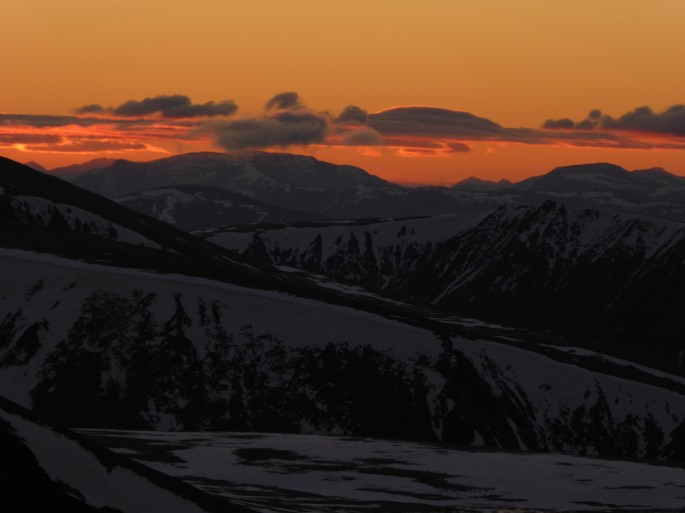
That aside, it was a stunningly clear day with uninhibited views in all directions. Any remaining snow was hard névé, just about manageable in my old Mantas without the need to resort to crampons, but you had to be on the lookout for hard icy patches, otherwise you’d suddenly find your feet going from under you – not good on a slope where the consequences of a slip could be dire but these gentle snowfields gave no such cause for concern. The sunset, viewed from Cairngorm itself, lacked the fierceness of last week’s skies, but provided a spectacular sequence of colour changes over the ridges of the Northern Corries. The final part of our descent back to the car park was done in darkness. As we arrived at the car we looked back to see the lights of many other headtorches making their way down Coire Cas. We were not alone …. it sure is busy ‘up north’.
Whenever there is serious snowfall, the mountaineering fraternity goes wild, the reason being that the winter season in the UK can be so short (this is in terms of snow arriving and lying the mountains, and not the ‘general’ winter season – which does have a tendency to go on forever) that you simply can’t afford to waste any opportunity to get out there. However, when the snow falls in earnest, it tends to be non-selective. The ideal scenario would be for the snowfall to tamely confine itself to the mountains, while roads and car parks remain beautifully clear. Dream on. So, when the snow arrived at the end of last week, we had to think carefully about which hills it might be possible to access. The main roads were likely to be open, but narrow, minor roads into various glens might prove treacherous to negotiate – and as for parking spaces, yes we had a shovel, but did we really want to begin a winter hill day already shattered after having had to dig our own parking space? With this in mind, we opted to park at Keiloch (Invercauld), just off the main road to Braemar. Clearly many others had had the same thought process – and so it wasn’t surprising that the car park was already fairly full when we arrived.
The forecast was an odd one, with neither the local weather prediction or the MWIS (Mountain Weather Information Service) being in agreement. Being clothed for minus 5 in the glens and being prepared for a similar temperature plus the chill from 40-45 mile per hour winds on the summits proved to be an error of judgment. It was clear from the start that it was going to be a much warmer day than expected, probably around the zero mark: it certainly had all the makings of a drippy, semi-thawing snow day. So as we made our approach through the forest, there were a few halts to remove layers in order to ensure that neither of us started to overheat. Once out of the trees and across the burn, we started to climb. I stopped to adjust the venting system on my newish jacket – bought at a knock-down price in a sale (being small does have its advantages) and then left unused for over a year – but a very fetching 2-tone purple that eventually proved too much to resist. Kit failures 1 and 2 ensued. The taped pit zips on my shell layer refused to budge. I had to shed my rucksack and perform some strange yoga-type movements in order to get them open. Had the designers ever tested this jacket??? In the process of this battle, my left silk liner glove was completely destroyed. Again, this was a relatively new item. Why bill silk liner gloves as ideal mountaineering equipment when they aren’t robust enough to even cope with the mere opening of zips (OK, granted these were difficult zips – but still?)…
Views north to Culardoch
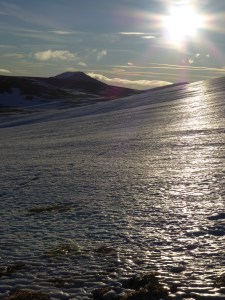
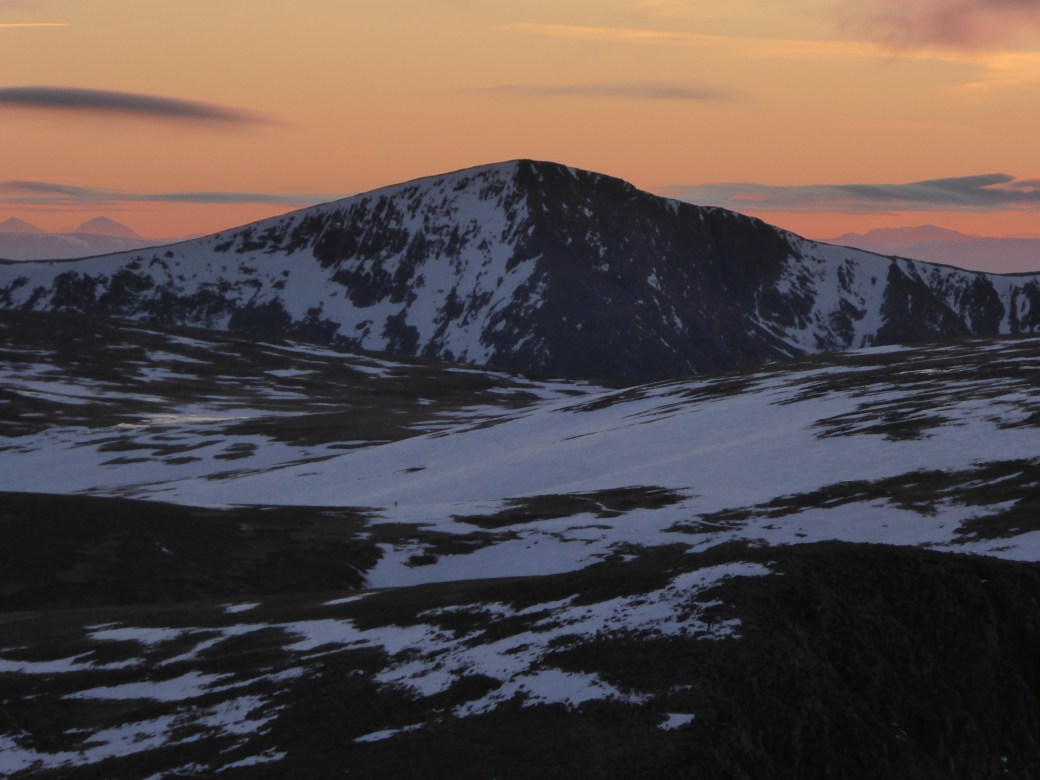
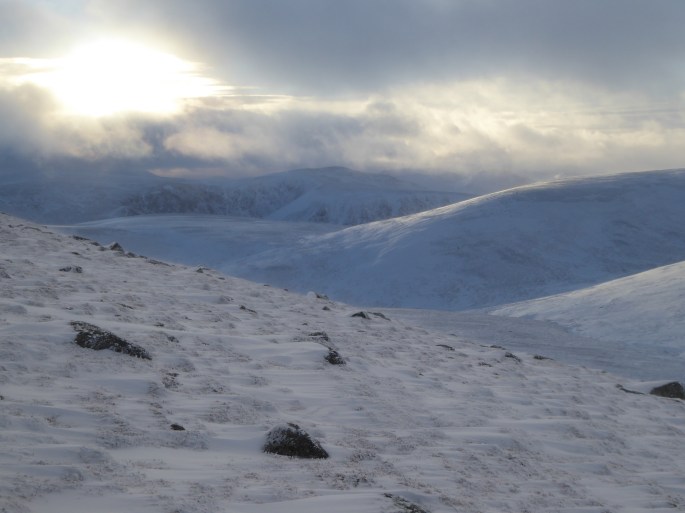
We carried on, and as we got higher, it was windy, but nowhere near as desperate as the MWIS had suggested. The cloud base lifted gradually and eventually the wintery upland landscape was under a continual shifting light pattern, sifted through the rapidly racing clouds. Tendrils of spindrift snaked their way across the snow-covered ground, converting themselves into blistering sprays of crystals in stronger gusts of wind. From time to time, a snow hare would dart out from in front of us and race for cover elsewhere, hunkering down and flattening ears close to bodies in an effort to conserve heat. We went over Carn an-t Sagairt Beag (1044m) and then up to the summit of Carn a’ Choire Bhoidheach (1110m). A retrace over Carn an-t Sagairt Beag to its neighbouring higher summit of Carn an-t Sagairt Mòr (1047m) meant that we were now facing into the wind. I donned my goggles only to discover kit failure no. 3. My googles (again newish – and, it must be said, not cheap) demonstrated an annoying tendency to completely steam up on one side. The left side of my world was fogged over, but with the wind in my face, I needed the goggles on. We continued. The sun started to sink behind the distant hills. The approach from the north east to Carn an-t Sagairt Mòr is steepish and about half way up we hit a patch of hard névé, pretty much a layer of ice. Iain, in his double plastic boots (why on earth was he wearing those – they looked ridiculous!?), skimmed up the slope effortlessly. My old Mantas with starting-to-wear profiles got me about 5 steps up. Using the boot edge as a tool was proving completely ineffective, so grumbling, I retreated and re-tried, this time deploying the ice axe for step cutting. The icy névé was pretty solid and I could see me being there until midnight as I tried to carve out something resembling a stairway for myself. Cursing even more, I retreated again and whipped out my crampons (all good fun when working with liner gloves that provided no protection from the elements). Kit failure no. 4. I had checked at the beginning of the season that my crampons were correctly adjusted for my boots, but I had forgotten that there had always been a very slight mismatch between the right boot and its crampon. And now, the lever at the back of the crampon was rather loose on the boot. Eventually, I managed to adjust the system to the point where I felt happy that the combination of the straps and mechanism wasn’t going to cause any problem. And, finally, up I went.
Evening skies from the summit of Carn an-t Sagairt Mor
Summit attained, we descended (Iain now also wearing crampons for the descent over the névé and ice – naturally I took no satisfaction from his lone kit failure: the instep crampons he had lazily intended to slip on didn’t fit over his plastic boots – he insisted he had worn them for the entire circuit of the 5 Loch Muick Munros last year, but clearly had never checked for compatibility with other boots – [please note, instep crampons need to be treated with a hefty dose of caution: they cannot and should not be considered a replacement for full crampons under any circumstances]). It was getting dark and it became evident as we descended back towards the forest that the snow had become decidedly softer in the lower reaches during the day – that sort of waist-deep softness that doesn’t do any more for hurry than it does for already fraying tempers. Sitting in a nice horse shelter watching the snow gently falling, whilst devouring unusually copious remaining supplies of chocolate, helped restore some semblance of good humour. Once again, it was a long walk-out by light of head torches, but with the snow coming down was all rather therapeutic.
When I acquire new mountain kit, I expect to have to try it out in a variety of conditions and in combination with other items, but I do also expect the manufacturers to have tested items themselves. There was no excuse for those zips, the gloves or the goggles. It seems amazing now looking back on the kit worn to the mountains many years ago when still at school or as an impoverished student – any old shirt and trousers (except that we all knew that jeans were a no-go), a non-breathable set of waterproofs, some cheap ski gloves, a headtorch with a battery the size of a generously-proportioned slab of vanilla cake and a bobble hat, all stuffed into a cheap £10 rucksack. I would say that it all worked just fine, but of course it didn’t, we just didn’t know any better (but it certainly lasted well, vaguely did what it was supposed to do, didn’t cost the earth – and of course never went out of fashion…never having been stylish in the first place). That said, the spare liner gloves I finally located at the bottom of my pack late yesterday did cost just £1.50 from the local petrol station… and, unlike those upmarket silk gloves, they cheerfully withstood the final ferocious fight that I had to have with the zip of my shell jacket – just so that I could take the wretched garment off at the end of the day …
Mount Keen (939m) tends not to be held in great esteem, despite its unique claim of being the most easterly Munro. Once bagged, it’s then frequently forgotten and not revisited. However, for those of us living in the North East of Scotland, an annual appointment with the mountain is obligatory.
Looking towards the Cairngorms
While the mountain itself may not be that visually stunning, the lengthy approach from the north through the Caledonian pine forests of Glen Tanar is undeniably very lovely. I must confess that my New Year’s Resolution to rise earlier and drive to hills that don’t require such a long approach has already failed dismally (see last post), this being reflected in today’s nice short drive but then a 29 km plus round trip on foot. The benign weather conditions and lack of snow were most un-January-like, but the views across to the Cairngorms had all the clarity of the midwinter. Walking back through the pine forests in the moonlight was a truly magical experience: it more than made up for me failing to fulfil my New Year’s Resolution at such an early date.
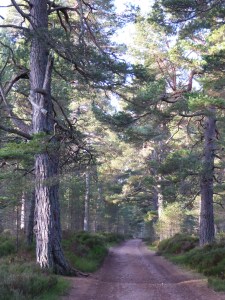
Pine trees in the moonlight
Featured photo: The shadow of Mount Keen cast on the landscape below
Can being prepared for any eventuality and worst-case scenario be the cause of problems out on the hill?
The answer is simple. When you struggle to keep moving at a consistent and reasonable pace, when you drain your energy resources, when it’s near impossible to physically lift your rucksack by yourself, then you know you’ve got a problem. Something’s wrong.
We’ve all done it: put together that expedition rucksack that weighs a tonne. Even though you’ve gone through the contents with a fine-tooth comb and reluctantly evicted all ‘luxury’ items surplus to requirements, exchanged heavier clothes for lighter options and used that time-honoured backpackers’ trick of cutting off the handle of your toothbrush in an effort to minimise the load.But what happens when everything that remains still seems essential and non-negotiable?
Looking N from White Bridge
Last week our aim was to take in both Beinn Bhrotain and Monadh Mor from Linn of Dee, which meant a long approach on the flat before we started climbing. The conditions weren’t great. Strong south-westerlies, up to 50 mph, but mild enough (at glen level, temperatures around 6C) that the recent snow had melted at lower levels… meaning that the already boggy approach to Carn Cloich-mhuilinn (941m) was totally and completely saturated. My rucksack was a) ridiculously heavy and b) very uncomfortable, constantly listing over to one side, no matter what I did in order to straighten it. As soon as we started to climb, my speed dropped off the radar. Between 750m and 950m the winds were brutal and my rucksack (only 40L, but a ‘tall and narrow’ 40L) started to act almost like a sail. Towards the summit of Carn Cloich-mhuilinn I was virtually crawling to avoid being knocked off my feet – not a great angle at which to be when having to support my hefty backpack. Once over the other side, and indeed all the way up to Beinn Bhrotain (1157m) itself, the wind wasn’t so much of an issue. I toiled up the snow fields to the summit (footage of conditions up there supplied!)
At this point it was getting dark and we decided against carrying on to Monadh Mor. The wind was even worse on the return over Carn Cloich-mhuilinn, which meant I was physically knocked off my feet a couple of times. By this stage, I was really tiring. Even reviving myself with energy-high food wasn’t helping. I had one speed and that was SLOW. I negotiated the very dreadful boggy area (heather bashing at this stage of the day was worse than no fun at all), onto the path, finally admitting defeat about 3km before the car park and grudgingly offloading a few items to Iain.
Out of curiosity, back at home my rucksack was put on the scales. 13.7kg. Without food. Now for some people this may have been no problem, but when you’re not that tall or well built, 13.7kg plus is a tall order. The recommended weight for a summer expedition pack should be around 12kg. Yes, I can lift 20kg bags of horse feed and move them without too much trouble, but sustaining 13.7kg on your back for an intended-fast-moving ten hour mountain day is a somewhat different matter. But just how did my rucksack end up being 13.7kg? There were two main reasons.
This sounds obvious: weighty items.
The rucksack itself (empty) weighed in at 1850g.
Ice axe (583g), crampons (approx. 850g) and blizzard bag (385g) all add to the weight – but must be carried. The blizzard bag is slightly heavier than an ordinary survival bag, but with a warmth rating of 3 tog, it is worth carrying that extra 100g or so.
First aid kit. It would be nice to be prepared for ‘saving the world’ and to have every last item that might make the difference, BUT this was a personal hill day, I wasn’t guiding, and therefore the size of the first aid kit needed to reflect this.
The amount of liquid I was carrying wasn’t huge (around 1 L), but the flask would have added to the weight. However, I find it impossible to drink ice cold beverages, so for me a flask is a necessity in winter. Non-negotiable.
I was carrying my waterproof layer at first – a Paramo layer that weighed 840g. Paramo make fantastic garments, far more breathable than Gore-tex and ideally suited to UK conditions. They take some getting used to and I tend to use mine not just as waterproof layer, but for insulation too, so this requires a different approach to using Gore-tex as the hard shell. The downside is that Paramos are heavy and bulky.You often hear that Paramo has to be worn and not carried, and for good reason. Maybe my layering system needs to be re-thought to ensure that I’m wearing my shell from the start.
All those smaller ‘useful’ items really add up:
Insulated trousers (295g). Yes, these turn a miserable night out in a bivvy bag into something decidedly less miserable, or are a great help if one has to sit around for any lengthy periods (e.g., in an injury situation or if benighted on the hill, for whatever reason)…but then I’m sure there are many items which would be nice to have, just in case…
Hand and headwear: there was a reason for every item (ooops, was that really 14 pairs of gloves and mittens?) and an obvious situation in which they might be required…and each weighs so little…but all these little things add up. If I had been spending a day climbing, where handwear was going to be regularly soaked through and I was going to be spending longish periods of time not moving, then the more gloves and mitts the better. This just wasn’t that type of day. 6-7 pairs of handwear, carefully selected for purpose (thick outer gloves, liner gloves, mitts etc.) would have been sufficient.
Three headtorches. Yes, I needed my main headtorch for a good 4 hours of this trip. But I had a spare in the top pocket, then my small emergency one in my first aid kit. I was out with someone who also had a back up. We could have managed if either or both main headtorches had suffered non-battery related failure.
Batteries. The mantra is ‘always carry spare batteries’. But batteries weigh a surprising amount. For a start there was no need for a dedicated set of spare batteries for each and every device carried. Checking the batteries before going out on each trip, having one back up set and/or being prepared to swap between devices if necessary may be a strategy for me to adopt (making sure, of course that all my devices will take the same battery!)
Smartphone and basic mobile. The smartphone packs a punch in terms of weight when compared to my old mobile. My basic little Nokia is going to be far better for making emergency calls (the only reason that I carry a phone in the mountains) in hideous conditions (the thought of trying to use that touch screen in 60mph wind speeds and driving snow doesn’t bear thinking about), so why am I carrying two (especially when my smartphone has no mapping software or GPS functionality – yes, you’ve probably guessed, it’s a ‘budget’ smartphone)? Of course, a second phone is a very good idea as backup …. you can see the dilemma here…
I could go on, but you get the idea. If anything, the photo at the top of this post best tells the sorry tale of a day that turned out to be far tougher than it needed to be.
Toiling up the snowfields on Beinn Bhrotain
Moral of the story: where possible select lighter options, match amount/type of gear to the type of day (e.g., distance, terrain, weather and temperature), but without compromising safety. It looks as though that my winter rucksack will have to be re-packed in accordance with the type of day every time that I go out. The weight of my rucksack plus contents has certainly been an issue in winters gone by, but the day that I’ve just described went beyond the pale in terms of the misery that it caused me. A shorter day in terms of distance and objective and being prepared to move at a slower pace because of the weight would have made much more sense.However, when your nearest mountain range invariably demands a huge walk-in before you reach the foot of your hill, a mega-day will always be the result – particularly in winter. There’s nothing for it: for the next few months I’ll just have to get up earlier and drive to hills that are easily and directly accessible from the road (but, nonetheless, with a lighter load!).
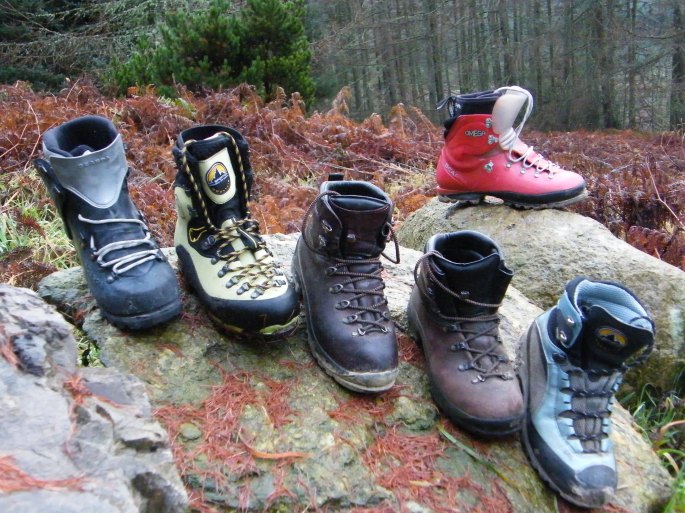
There’s a slightly surreal feeling as you find yourself surveying a winter boot collection accumulated over a number of years. At one end of the range (left) I have the boots that I loathe – the Scarpa Vega may, on other people’s feet, have scaled every 8000m peak in the world, but that doesn’t mean that anyone ever took any pleasure from walking in them. They are like blocks of wood, only less sensitive. I remember grimly struggling with these boots on the approach to the glacier on Cayambe in Ecuador. I also remember being laughed at in the Alps as being the only person in the entirety of France, Switzerland, Austria and Italy combined to be wearing double plastic boots. Oh yes, each and every last person in the Alps that summer was wearing the trendy La Sportiva Nepal Evo (second boot from left): solid, dependable, with thick leather to keep you warm and, like the Vega, graded at B3. These are the boots that I am presently taking on short jaunts to find out just how much damage they might do to my feet on an epic day. I’ve actually been pleasantly surprised: I’ve been expecting a similar agonising experience to the Vegas, which they haven’t yet delivered (yay!)… but they are decidedly weighty. They seem a bit of overkill for a Scottish winter (unless climbing higher grades) when compared to the gold standard Scarpa Manta (old model, centre, graded B2). Whether intentionally or not, this boot seems to have been designed with the Scottish winter in mind, able to cope with approaches through the bog, wet snow, scrambling over slippery lichen-covered rocks and the ubiquitous heather bashing as well as the more typical demands made of a winter boot. But perhaps the ultimate ‘all-rounder’ boot for Scotland, versatile enough to be used in summer conditions, but also a stalwart doyen for most winter conditions is the Scarpa SL (second from right). This is my year round go-to boot. My many pairs have seem umpteen Munro expeditions (summer and winter), have taken me up Shasta and Rainier in the Cascades and peak bagging in the US Rockies and trekking around all manner of terrains in New Zealand. In my opinion this boot is top of the B1 grade. I’ve spent entire days with crampons attached to this boot and they cope admirably. It is one of the few all-leather boots remaining on the market, and I’m hoping that Scarpa don’t make too many changes to this iconic model. At the lower end of the B1 grade is the La Sportiva Trango (right). It’s amazingly light and comfortable, but I’m not convinced that it will stand up to many months of traversing sharp scree or scraggly heather. And that’s why I avoid taking them over too much of this. Obviously it’s a matter of opinion but personally I don’t find that these offer sufficient ankle support to permit more than occasional use of crampons.
….and finally the Scarpa Omega in the background, which insisted on photo-bombing my collection: I was looking for pair of these (rumoured to be warm and very lightweight for a double plastic boot- and ideal for Scottish winter conditions) … and what happens? My husband finds a pair in his size in the sales ….like he needed another pair of boots…. but that’s another story.
(Note: To be fair to the Scarpa Vegas they do come into their own on icy terrain. They are warm – which is an absolute necessity at high altitude, unless you’re wanting frostbitten toes – and they are, above all, bombproof. I’ve spent numerous mountaineering trips trying to destroy them and haven’t yet succeeded).
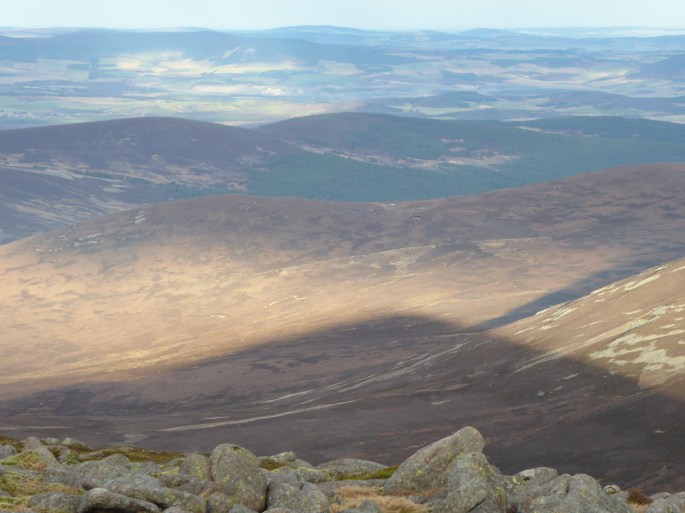
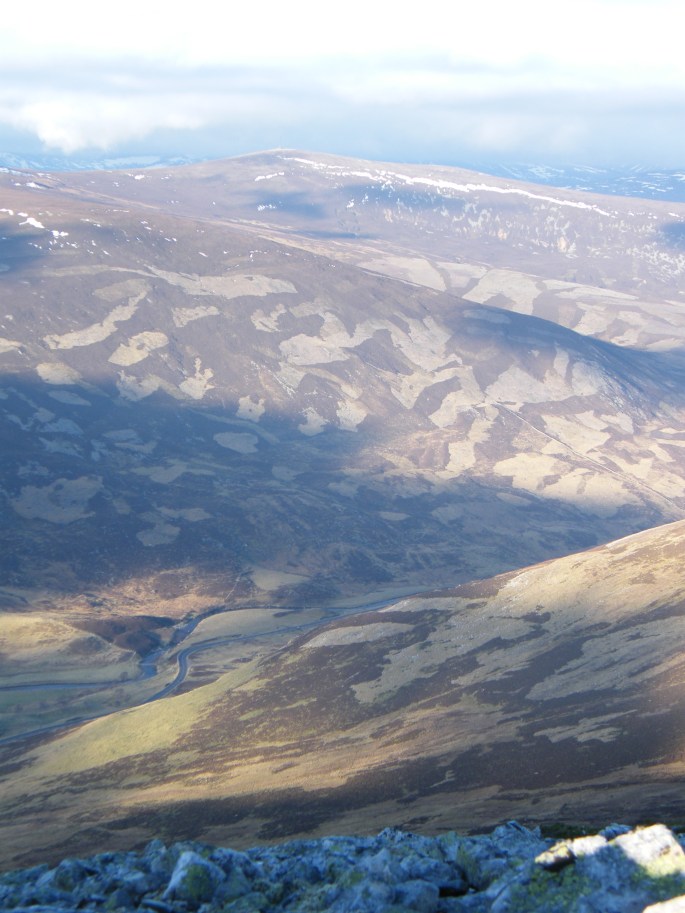
The photo shows how little snow remains in the Glen Shee area, with mere patches on the high Cairngorms in the distance. We were in the sun for most of our short jaunt on Creag nan Gabhar, but to the north and east, a blanket of cloud lay over the higher peaks. However, despite the lack of snow, the wind chill at the summit soon reminded us that it was actually December and all extra layers had to be donned in order to sit, admire the views and enjoy lunch.
Heavy rucksack, heavy boots: can only mean one thing – winter is here. North ridge of Carn Aosda from the Baddoch Burn, then on to Carn a’ Gheoidh. The sun was setting as we left our last summit, so back over Carn Aosda, then down the ridge in the dark. Temperature a steady minus 2, but falling as the evening drew in. All good fun!






 A retrace over Carn an-t Sagairt Beag to its neighbouring higher summit of Carn an-t Sagairt Mòr (1047m) meant that we were now facing into the wind. I donned my goggles only to discover kit failure no. 3. My googles (again newish – and, it must be said, not cheap) demonstrated an annoying tendency to completely steam up on one side. The left side of my world was fogged over, but with the wind in my face, I needed the goggles on. We continued. The sun started to sink behind the distant hills. The approach from the north east to Carn an-t Sagairt Mòr is steepish and about half way up we hit a patch of hard névé, pretty much a layer of ice. Iain, in his double plastic boots (why on earth was he wearing those – they looked ridiculous!?), skimmed up the slope effortlessly. My old Mantas with starting-to-wear profiles got me about 5 steps up. Using the boot edge as a tool was proving completely ineffective, so grumbling, I retreated and re-tried, this time deploying the ice axe for step cutting. The icy névé was pretty solid and I could see me being there until midnight as I tried to carve out something resembling a stairway for myself. Cursing even more, I retreated again and whipped out my crampons (all good fun when working with liner gloves that provided no protection from the elements). Kit failure no. 4. I had checked at the beginning of the season that my crampons were correctly adjusted for my boots, but I had forgotten that there had always been a very slight mismatch between the right boot and its crampon. And now, the lever at the back of the crampon was rather loose on the boot. Eventually, I managed to adjust the system to the point where I felt happy that the combination of the straps and mechanism wasn’t going to cause any problem. And, finally, up I went.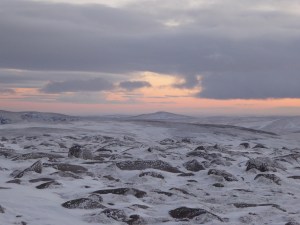


 Places Wild and High