Guest blog by Iain, who’s been enjoying the wonderful winter conditions in the mountains …
It always surprises me when people aren’t perhaps a little shame-faced about refusing to climb the same hill multiple times. Seems a pretty clear indication that it was only climbed in the first place to allow it to be ticked off a list. After all, like crossing a river, it is nigh-on impossible to climb the same hill twice and have the same experience. Sometimes the experience is so different to the previous visit as to bear no comparison.
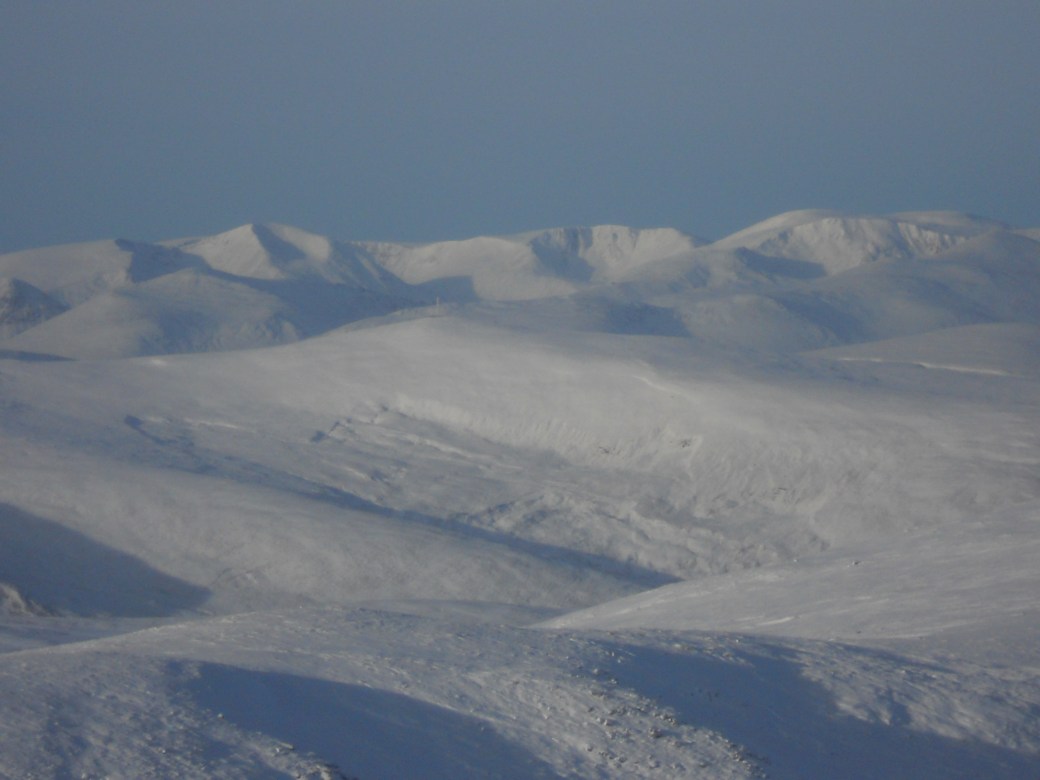
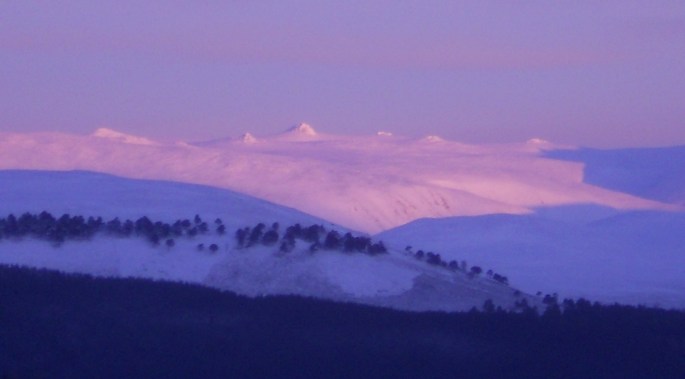
This year has been a good example of what I mean. OK, I will admit that the January 1st ascent of Mount Keen is perhaps not one I will remember as having been more than a pleasant day out. But from then onwards it has been an excellent year full of new experiences, in spite of it involving the same hills I always do at this sort of time of year – and all of them in pretty good weather. A snowshoe-supported round of the Loch Callater hills was noteworthy for the lack of seeing anyone “on foot” – not even any footprints. The only other person able to get up there was on skis. As part of the quest for new experiences I thought I would settle down at the summit of Cairn of Claise and wait for the sunset to develop….wearing two pairs of gloves and a pair of mittens, a headband, a hat, a thick winter jacket, a thick primaloft jacket and a thin down jacket….all with the hoods up. The sunset was indeed stunning, but I had to head off before it reached its zenith as I was shivering so badly I could no longer operate the camera.  However, the thing that struck me most was the discovery that a mere two or so miles away and only a few hours earlier, a friend was climbing An Socach, just in a base layer and only needing gloves and a jacket on nearing the summit. Different world indeed. Even the wearing-on of the afternoon makes the mountain change in ways you might not really expect – I love the way the feel of the snow changes as it hardens up just from a small drop in temperature….though I am not so fond of when it instead softens up after a day of sunshine and, instead of skittering lightly over the surface, you sink in over your knees.
Heading back to the same area two weeks later really underlined the way the snow changes, with a round of the Loch Muick hills, starting with Lochnagar. The ascent Lochnagar from the Loch Muick carpark can indeed feel a bit repetitive (even more so for those laden down with a mass of climbing gear) but even it has been different every time – last year I entered the cloud as soon as I reached the cliffs and only suddenly exited when I moved two metres north of the summit – yes visibility was pretty much zero on the summit but a mere two metres down from it was enough to get into a stunningly sunny day. This year, all that lovely thick snow had suddenly turned to rock-hard ice. I lazily put on snowshoes to go up the boulder field, rather than crampons, simply because they were easier to reach. Thus, I not only looked totally ridiculous clambering up the crowded summit in them, but later suddenly found myself inadvertently skiing down the eastern side of White Mounth, as they completely failed to grip the ice. Clutzy yes; dangerous, not really. The middle two hills, Carn an-t Sagairt Mor and Cairn Bannoch were just as empty of people as when I had been on them the previous week, but had a completely different feel about them, when covered in ice rather than snow. The major difference though was that, for no obvious reason, I was absolutely shattered (and will admit that I later had to resort to listening to an audiobook to keep my mind off how curiously tired I felt). The other difference was how much more light there was. I had been aiming merely to get back to the pony hut (where the track starts at the bottom of the final climb up Broad Cairn) before it was completely dark. Instead I was back down at the Loch. What a difference even just two weeks makes to the length of the day!

Last weekend, with a rather dismal forecast, I headed up Culardoch and Carn Liath, two easily-accessed Corbetts at the eastern end of the Cairngorms – now surely this would be a generic day out: I would trudge through the forest and up the track, maybe getting the odd view through the mist, maybe finding a light coating of snow, but otherwise it would be unmemorable and probably nothing more than a bit of exercise and an excuse for a lot of junk food. Well, that is roughly how it seemed until about 600 metres, albeit with a considerable layer of snow on the track, when suddenly I popped out of the cloud and into a blue and white wonderland, with breath-taking views across the layer of cloud to Lochnagar. 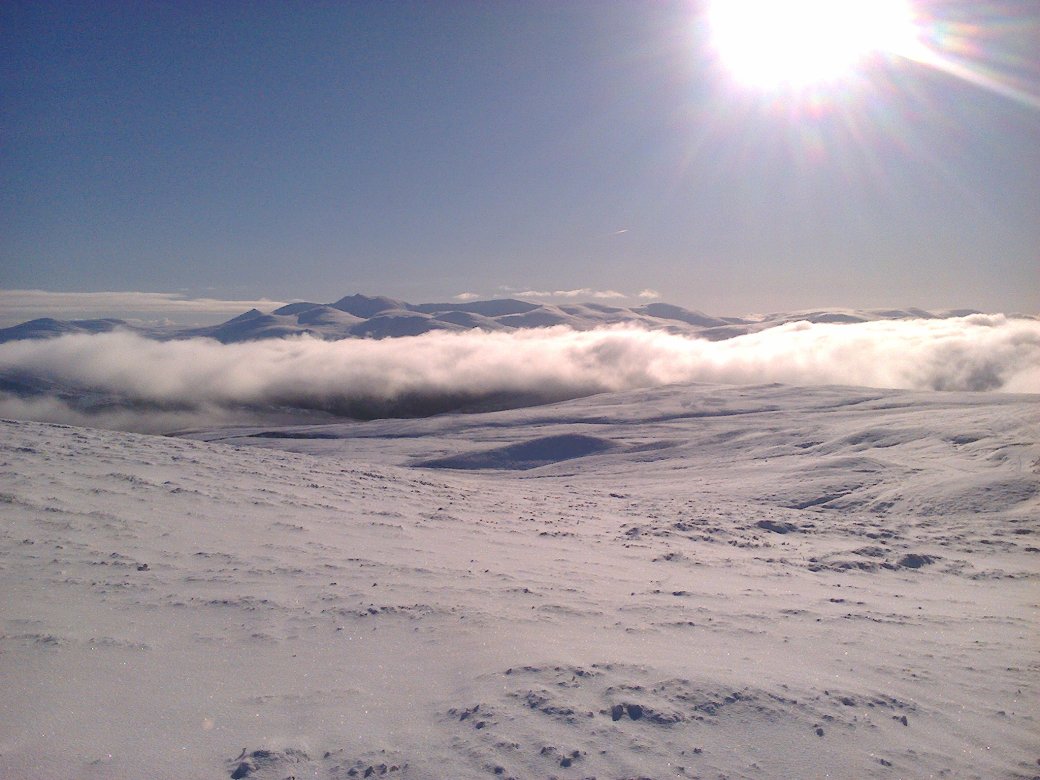 Even with snowshoes on, the ascent of Culardoch was hard work. Sitting on top of Carn Liath watching the sunset just in a light softshell, noting that there was absolutely no breeze or sound, I could see through to Cairn of Claise and was reminded of how perishingly-cold it had been there just a few weeks previously.
OK, let’s not get too carried away: there are some days out that do feel pretty generic and non-descript, and disappear from memory rather quickly. There are of course those that you remember because of how truly awful they were (Jasmin will remember all too well my “just follow the effing fence posts!” outburst in Glen Lyon – there are so many hours of torrential rain-meets painstaking micro-navigation before some tempers fray and you just want to get down by the quickest and easiest method). I can even remember days because of how crushingly boring they were – an ascent in the Mamores with zero visibility and zero breeze was like being in a sensory deprivation chamber all day. Amongst the strongest memories, as they are perhaps the ones in which the biggest shift in how you were feeling occurred, are those in which you suddenly pop out above the clouds. A few years ago we did Glas Tulaichean on a day so dismal I would genuinely rather have been shopping or flicking through the channels on the TV….it simply sucked the life out of you. Cold and spitting rain, poor visibility, a path covered in yucky slushy snow and streams in spate. What on earth was the point in being out – especially as everyone else had decided not to bother? Well, about 50 metres short of the summit, we popped out of the cloud. Everywhere else in Scotland, as far as we could see, was under the cloud and no other hills were visible.


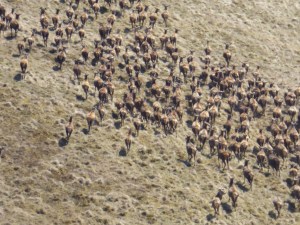
OK, so that was the definitive ascent of Glas Tulaichean and every other visit would be kinda underwhelming? ….well actually the next year we approached it up the Cateran Trail via the intriguing Beinn Earb (always noted on the map, as it really stands out but….it isn’t on any list so why bother?). This gave a superb springy high-level walk, always around the 700 – 800 metre level. At this sort of level, one would normal anticipate a dispiriting bog! Instead it was a splendidly unexpected find. Even better was the sight of a line of over 100 deer all gracefully jumping (or very much less gracefully tripping over for some) the same high fence right in front of us. OK, so maybe Glas Tulaichean itself wasn’t exactly memorable once we, many, many hours later, finally got to the summit.


So, in the same way as there is bad weather (not just bad clothing – 100 mph winds = bad weather!!!) there are doubtless also boring hills (and not just boring people) and really boring days out – but there are far fewer unmemorable days out than you might expect, even if you do the same hills over and over again each year.
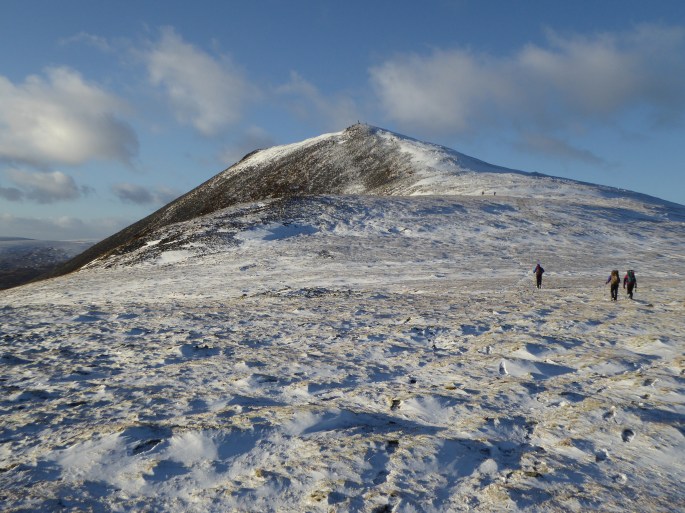
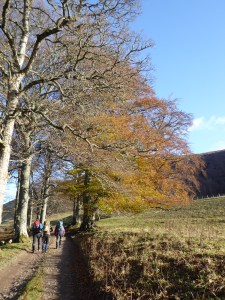
 Temperatures across the North East of Scotland have certainly plummeted this week, but it was already fairly cold last weekend when we headed over to Blair Atholl to climb Carn a’Chlamain. The previous few days had been wet, so the idea of a long walk-in on a dryish track had its appeal. The mountain forecast was not overly encouraging, but the day turned out fine: it was far less windy than suggested and as luck would have it we had picked an area that managed to remain in sunshine for most of the day.
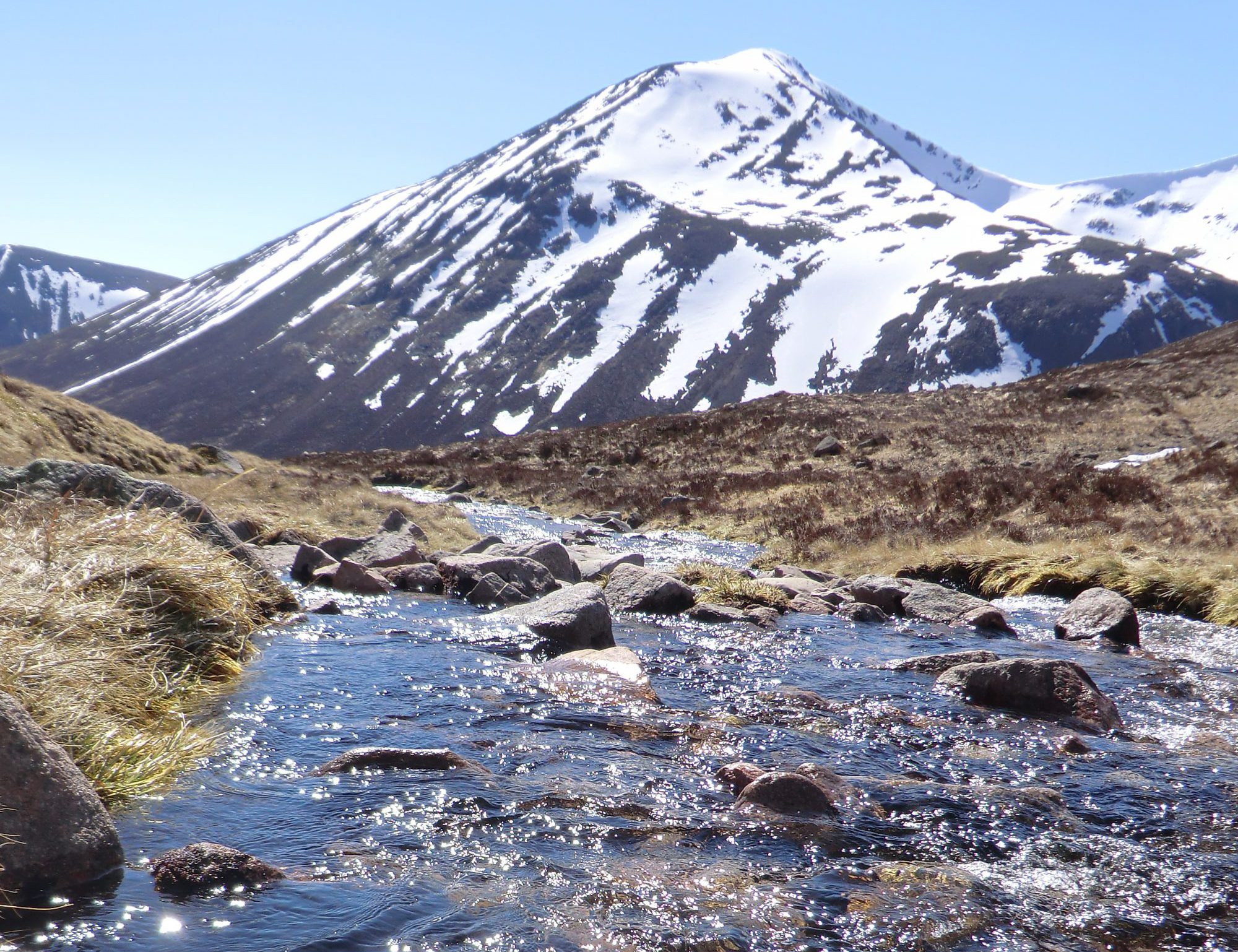
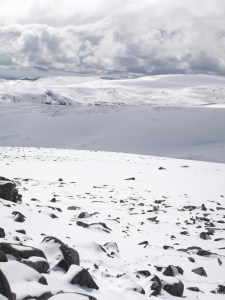
  At higher levels there was a fairy-tale dusting of snow, while further up the wind had scoured the slopes, leaving exposed icy patches. The photos from the summit show a fair covering – a taste of things to come. A perfect winter mountain day with stunning visibility, a colourful sunset and a walk-out by the light of head torches.



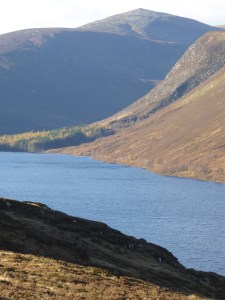
 Loch Muick with Lochnagar in background (B&W): This image was taken along the Capel Mounth route from Loch Muick (pictured) to Glen Clova. The bleached grass in the foreground, together with the rock to the left, while presenting a foil for Loch Muick and Lochnagar behind, are actually dominating the photo.
 Loch Muick with Lochnagar in background (colour):There is still a high level of contrast between the blonde grass and the background, but in this case the colours of the Loch and hillside create a more balanced impression. There is more ‘awareness’ of the background.
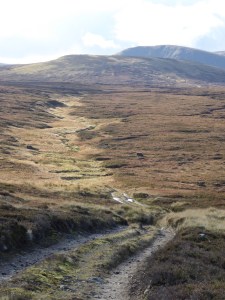
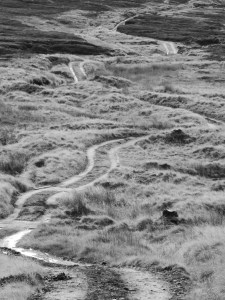

 Looking towards Glen Clova (B&W): The inward facing slopes of these hills draw the eye towards the distant forest at a lower level. The upland area behind remains firmly in the background due to the washed out shading.
 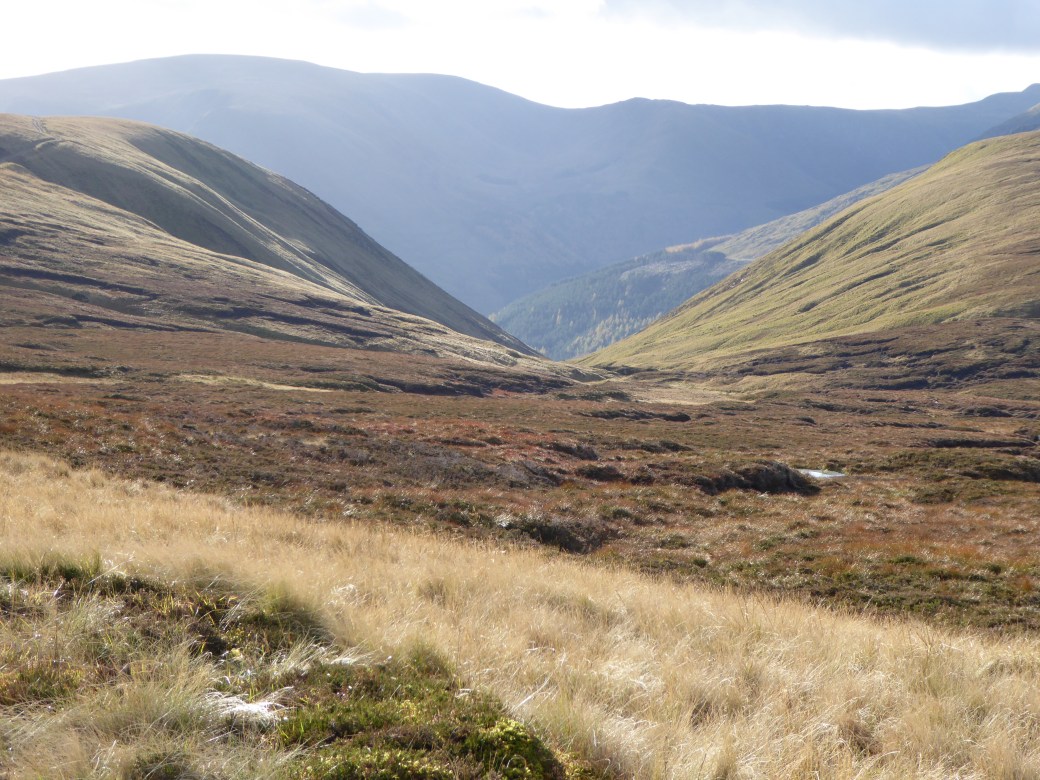 Looking towards Glen Clova (colour): The background comes across as even more remote here. The shape of the middleground hills do not make as much of an impact as in the B&W photo. The colours are almost a distraction, drawing the attention away from the bones of the landscape.
 Looking down into Glen Clova: the quality of the light has given both images a soft focus character. To me, much B&W mountain photography seems to work best with high levels of definition and contrast therefore the colour photo is more successful here. The greens and yellows add further to the softness of the picture. Of course, I may well change my mind about this with different light conditions – or at a different time of year.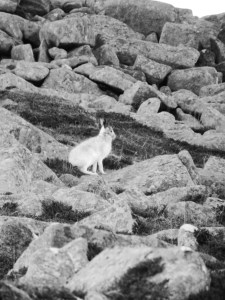




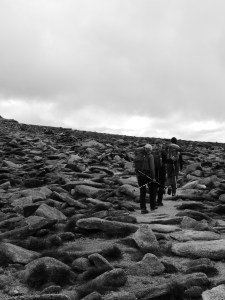


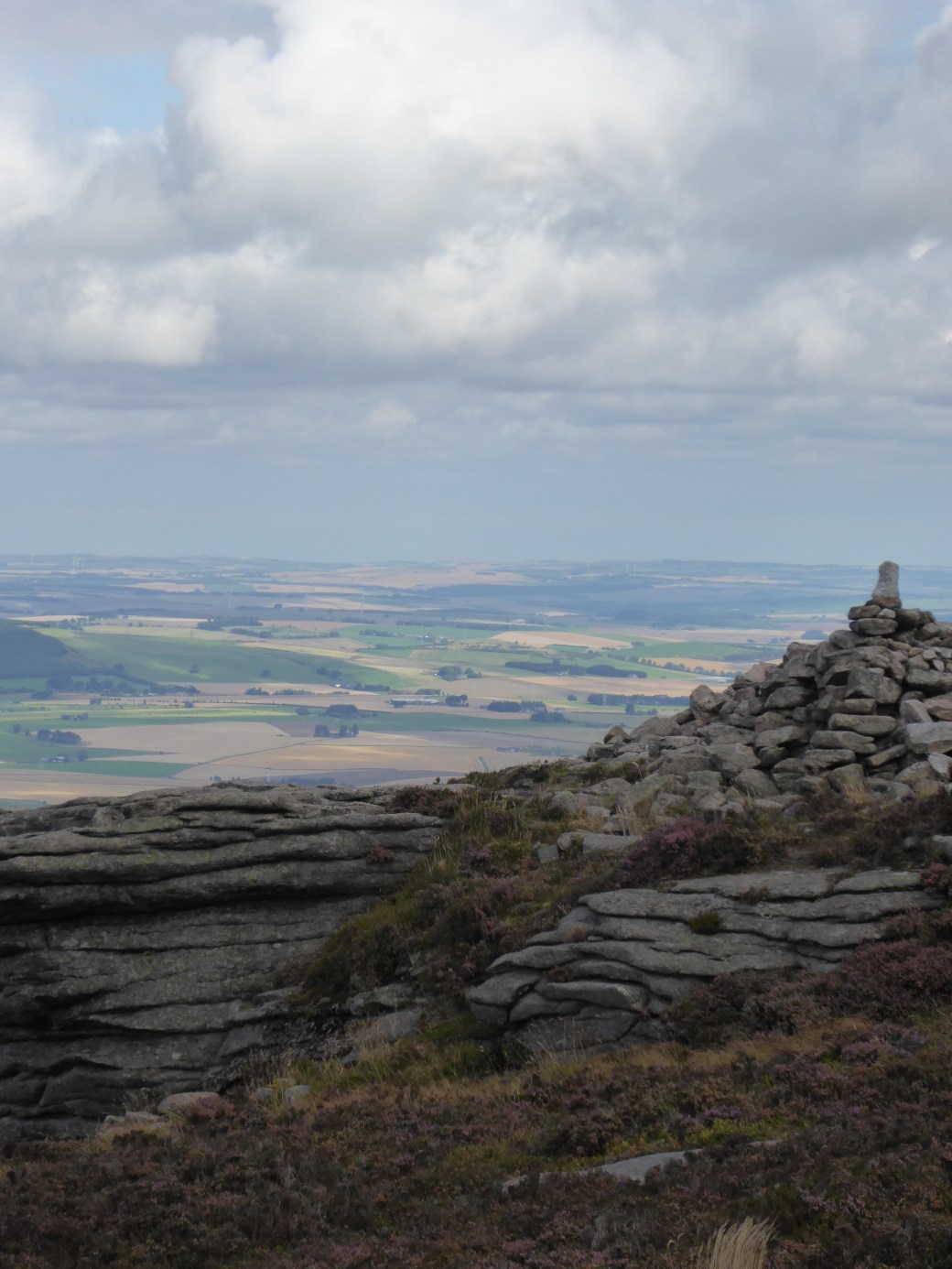




 The first attempt was made from Auchallater one April under snow conditions. However, time constraints prompted a descent to Glen Callater from the summit of Tolmount, rather than proceeding from there on to Tom Buidhe. A second attempt was made from Glen Shee, but due to navigational error the expedition ended up on neighbouring Tolmount. With limited daylight, the sensible decision to turn around was made – after all, Tom Buidhe wasn’t going anywhere – it would still be there for the next time…. Now the number three is highly significant in fairy tales (it features heavily in Goldilocks and the Three Bears, for example), so by this token, Mary should have bagged Tom Buidhe on the third attempt. This time, however, conditions were extremely challenging. Heavy snow made the going underfoot difficult, the wind was ferocious and visibility atrociously poor. A variant on the second route was chosen (coming up between Carn an Tuirc and Cairn O’Claise), but in the end the weather prevailed and Mary’s party beat a rapid retreat.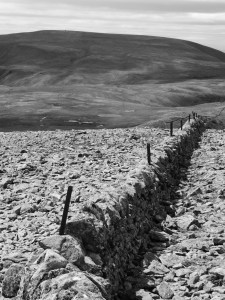
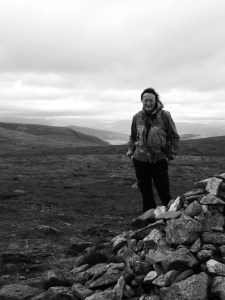
 Mountain days needn’t all be mega-taxing experiences. That epic twelve hour plus day, moving at the speed of light, with very few stops can be an extremely satisfying physical and mental challenge, but it often doesn’t permit the luxury of really engaging with the surroundings. The past few weeks have been about shorter hill days, enjoying the scenery, and really absorbing the beauty of the changing seasons. Observing the change of colour to the hills, as the brown washed out appearance as a legacy from the Autumn changes to the vibrancy of spring colours. Lower down, the trees, as is customary in the North-East of Scotland, hint at spring for weeks and then within five days have developed their full summer leaved appearance. This year it’s very much been a case of ‘blink and you’ll miss it’: that very pale yet intense spring green mantle of the woods and forests.


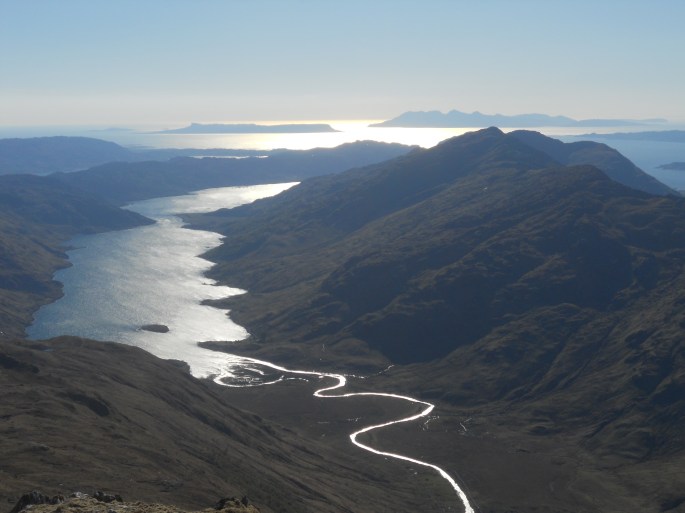


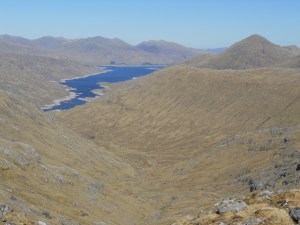
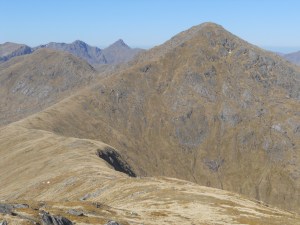
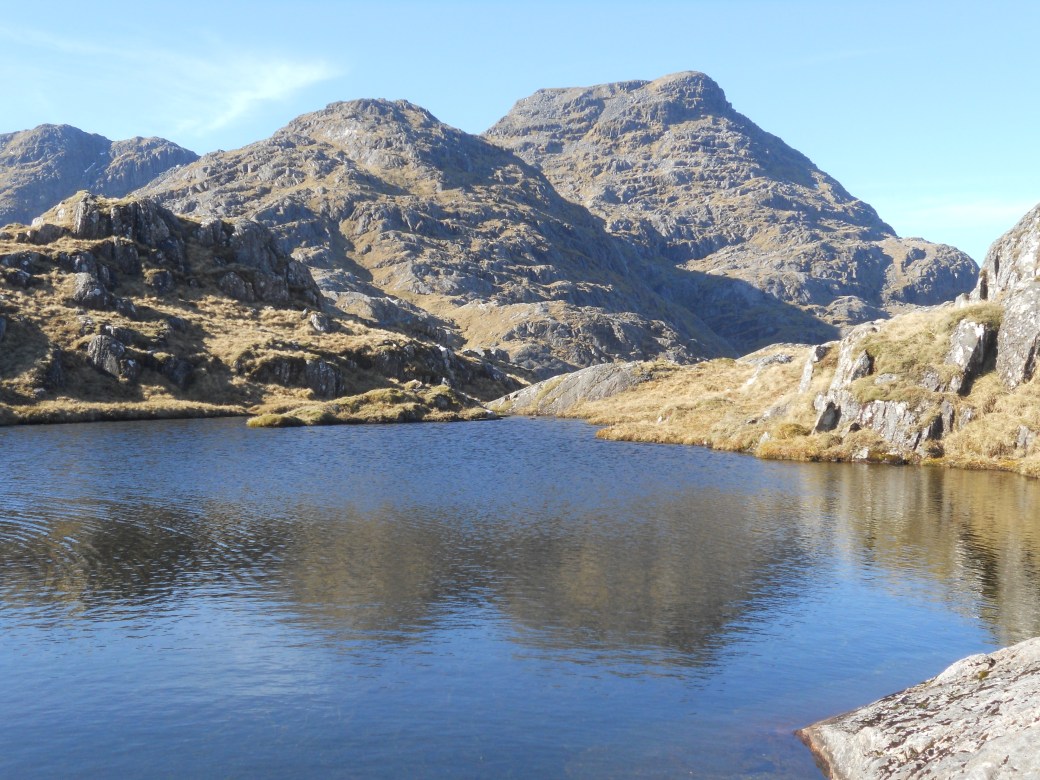
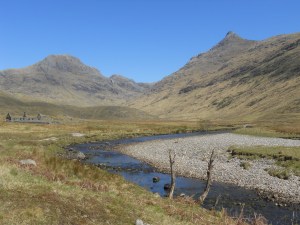
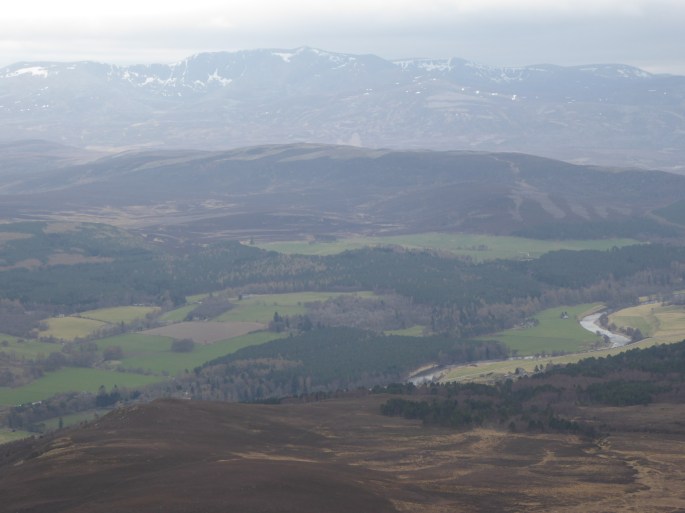
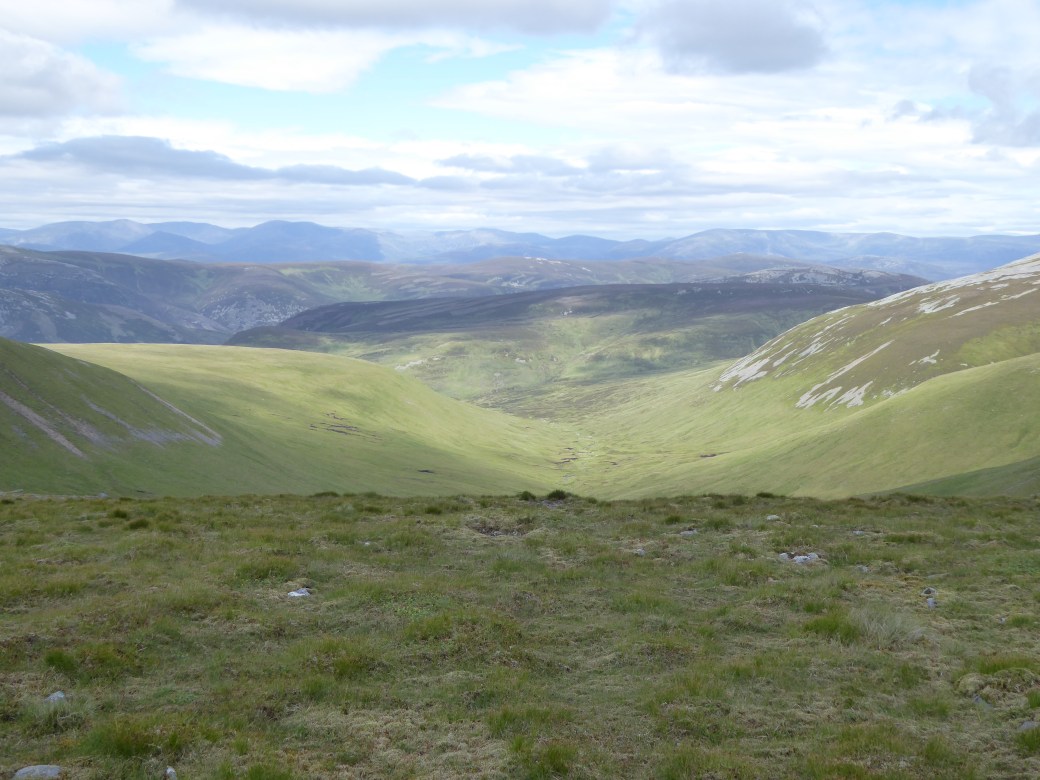
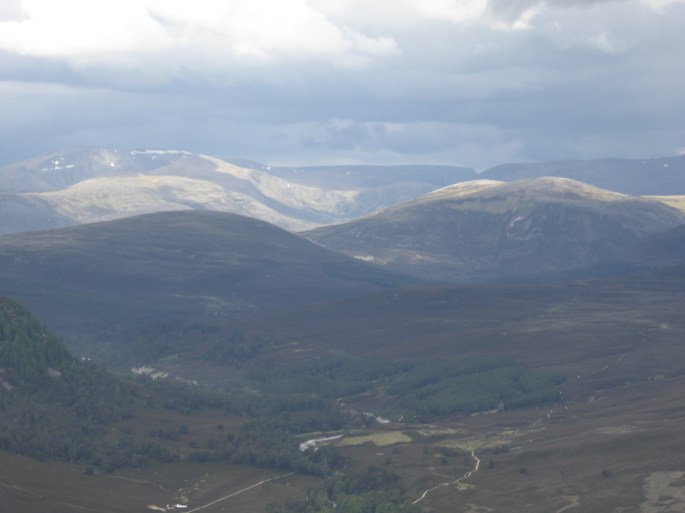
 I’ve always been fascinated by the layers of landscape that gradually reveal themselves as I climb higher on any ascent. Mountain days, no matter how short, always offer thought-provoking views, provided, that is, the cloud base co-operates and remains above the summits. And even in poor visibility, the altered, narrowed perspective can fire the imagination. Fitting the jigsaw puzzle pieces of the views from other mountains together is one of the rewards of visiting any hill, no matter what its height or situation. What lies over that hill or fold in the landscape? Where does that ridge lead? What route would I take from here to there?
 Recent days included a wander up Morven (871m) and a short, but fast ascent of Geallaig Hill (743m) from Braenaloin (both are hills near Ballater). Morven offered us stunning views of the surrounding springlike countryside, but the sunshine was deceptive: it was cold on the summit and most of my winter layers were required. Geallaig, a week later, proved to be equally as chilly, especially as the encroaching cold front complete with cloud and snow showers moved in to envelope the hill. The rapid change in conditions served to remind us just how raw the weather can still be in April. But the views (before we lost them) across to Deeside and Lochnagar beyond were superb.
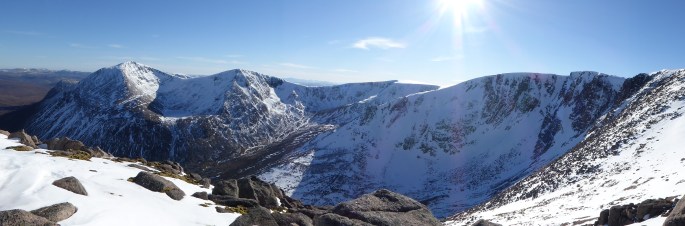
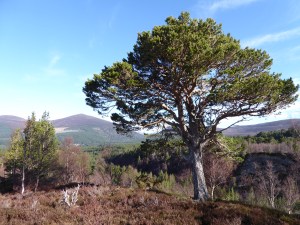 Some of my most intense memories come from days in the mountains. An elevated, different world, places that can’t be seen or imagined when you’re driving along the road through the glens. Days when time takes on different meaning, stretching itself out to the utmost while a vast number of experiences crowd their way into your memory. The landscape that imprints itself on your consciousness. And all this, regardless of the weather – whether it be battling with the wind to reach a summit, traipsing across extremely boggy ground with rain lashing at you, in the sensory deprived environment that constitutes a white-out, friendly white cumulus clouds creating a chequered shadow pattern over the world below you or a day of wall-to-wall sunshine and intense blue skies.
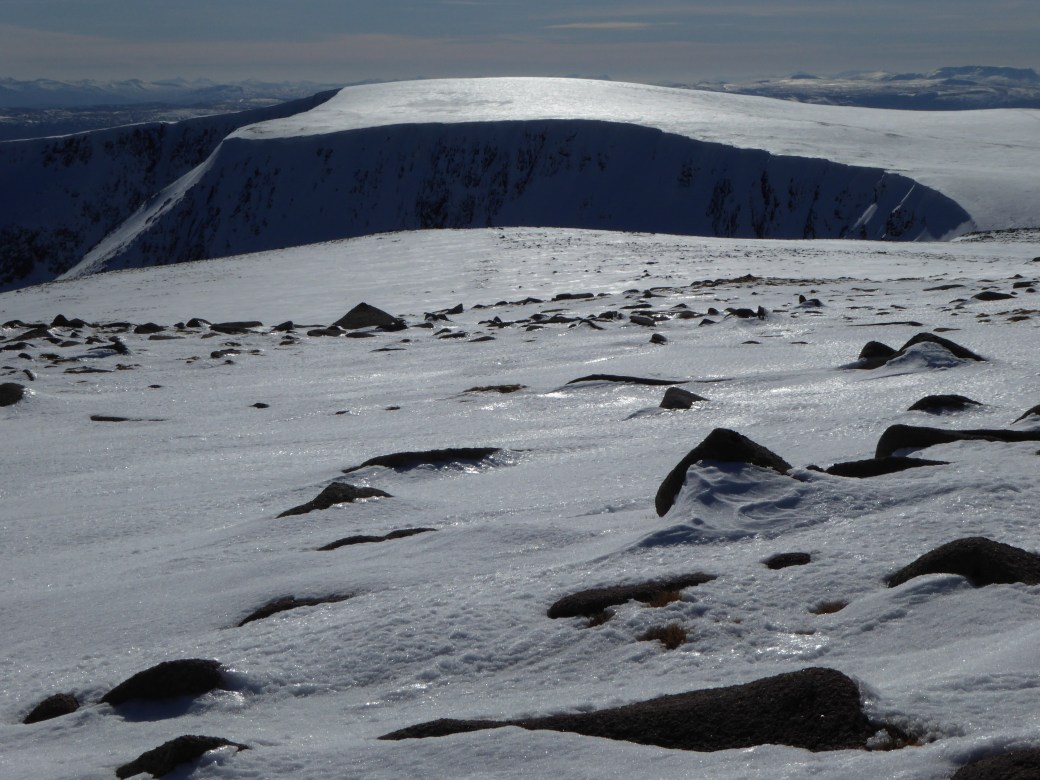 On the way up to the Braeriach plateau, I stopped to exchange a few words with someone who was on descent. The conversation rapidly turned to Nan Shepherd and her writings on the Cairngorms. This is a book that sits at home, beckoning me to read it (once I’ve cleared the numerous things that stand in the way). I was intrigued to hear how inspired my fellow mountaineer had been by this publication – to the extent that he had been on a mission to swim in one of the lochs in Coire an Lochan – and had been extremely disappointed to discover that it was frozen over.


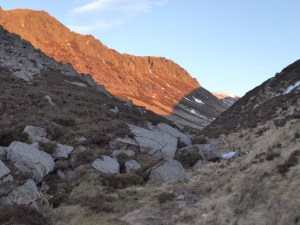 I ambled (no other word for it) downwards, wallowing in the luxury of being able to stop wherever, whenever. The sun was dropping and as I dropped down to the Allt Drudh I was deep in shadow. The sting in the tail re-ascent up the Chalamain Gap was not anywhere near as much effort as I had anticipated and I cruised up the path, noting the stunning orange glow of Lurcher’s Crag as the sun went down. Not particularly wanting to cross the Chalamain Gap in the dark, I had timed my arrival there to perfection. As I paused at opening to the ravine, I thought how much the scenery was reminiscent of Tolkien’s Mordor – down to the bare, stunted tree that was struggling to grow at the entrance.
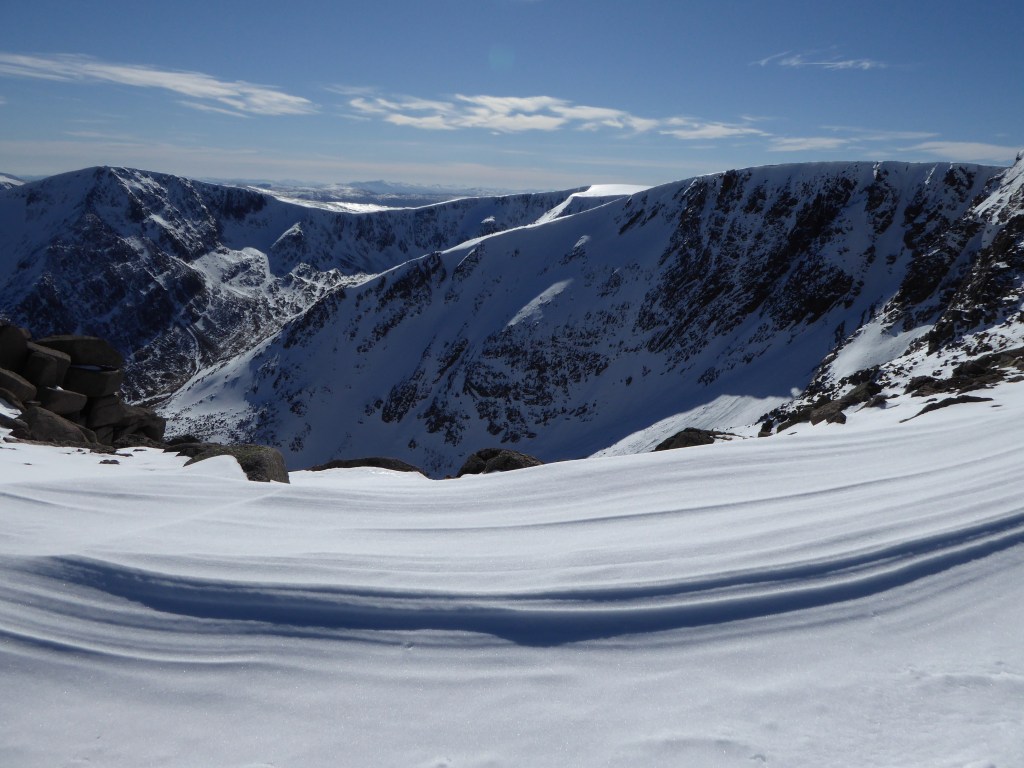
 Places Wild and High